What Is the Recovery Like After Getting a Dental Crown?
Getting a crown is one of the more routine procedures in dentistry, but routine does not always mean intuitive. Many people walk into the appointment thinking the hard part is the drilling or the impression. Then they get home, notice their bite feels slightly off, their gums are tender, or the temporary crown feels nothing like a natural tooth, and they start wondering whether any of that is normal.
Most of the time, recovery after a dental crown is mild and manageable. It is usually more of an adjustment period than a true recovery in the surgical sense. That said, there are a few phases, and each feels a little different. The first 24 hours are not the same as the first week, and neither is quite the same as life with the final crown in place several years later.
The experience also depends on why the crown was needed in the first place. A tooth that had a large but uncomplicated filling replaced with a crown may settle quickly. A tooth that had a root canal, deep decay near the gumline, or significant reshaping can be more sensitive afterward. Crowns placed on back molars can feel bulky at first simply because those teeth do so much work. Front teeth bring a different kind of awareness because you see and feel them every time you talk or smile.
If you know what to expect, the process is much less stressful.
What actually happens during a dental crown procedure
A crown is a protective cover custom made to fit over a damaged or weakened tooth. Dentists use dental crowns for several common reasons: to restore a broken tooth, protect a tooth after a root canal, support a tooth with a very large filling, improve appearance, or reinforce a cracked tooth that is still healthy enough to keep.
In a traditional crown process, the tooth is shaped so there is room for the crown material. The dentist then takes a digital scan or physical impression, and a temporary crown is placed while the permanent one is being made. At a second visit, the temporary is removed and the final crown is cemented or bonded into place.
Some offices offer same-day crowns made with in-office milling systems. In those cases, there is no temporary stage, which changes the recovery a bit. Patients usually avoid the annoyance of a temporary crown, but they can still have gum soreness or mild bite sensitivity because the tooth has still been prepared.
The key point is this: recovery after dental crowns is usually related to the tooth preparation, the gum tissue around it, and the way your bite meets the new surface. It is not usually about healing from a wound, unless the case involved additional treatment.
The first few hours after the appointment
Right after the tooth is prepared, your mouth may still be numb. That numbness can last anywhere from one to several hours depending on the type of anesthetic used. During that window, the biggest risk is not pain. It is accidentally biting your cheek, lip, or tongue. Adults do this more often than they expect, especially when talking or trying to eat too soon.
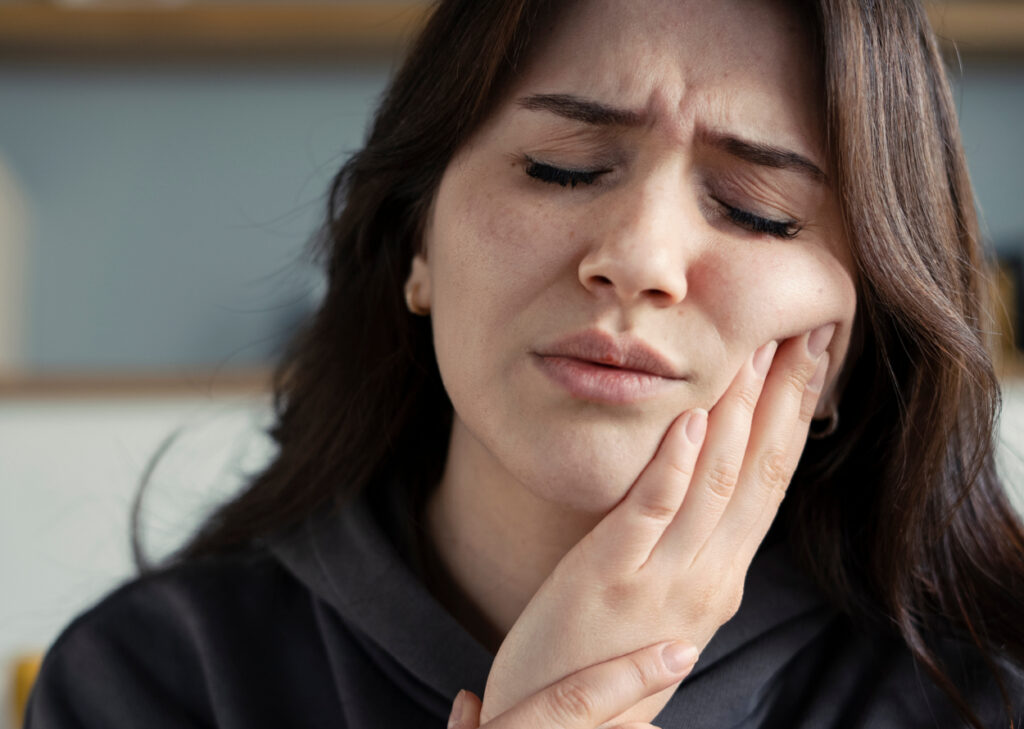
Once the anesthetic wears off, a mild ache is common. Patients often describe it as soreness around the tooth rather than sharp pain inside it. The gum around the crown prep can feel irritated because it may have been gently pushed aside during the impression or scanned around closely. If a retraction cord was used to help capture the margin near the gumline, there can be a little tenderness or slight bleeding afterward. That can feel dramatic in the sink but still be within the normal range.
If a temporary crown was placed, it may feel slightly smooth, slightly bulky, or just unfamiliar. Temporary materials are not designed to feel perfect. They are designed to protect the prepared tooth and hold the space until the final restoration is ready.
At this stage, temperature sensitivity is also common. Cold drinks can trigger a quick zing because the tooth has been reduced and is more exposed under the temporary. That sensitivity often improves on its own over a few days.
Why a temporary crown can feel strange
Temporary crowns deserve their own discussion because they are responsible for many of the calls dental offices receive after crown preparation. Patients often assume something is wrong when, in fact, the temporary is doing exactly what it is supposed to do.
A temporary crown is usually made from acrylic or composite resin and cemented with a weaker temporary cement so it can be removed later. It is not as strong, polished, or precise as the final version. That means it may feel less natural when you floss, slightly different when you bite, or rougher against the tongue.
There are trade-offs here. A dentist wants the temporary secure enough to stay on, but not so aggressively bonded that removing it damages the prepared tooth. That balance is why temporaries occasionally loosen or come off, especially if a patient eats sticky candy, chews gum, or flosses by snapping the floss straight back up.
A patient once described a temporary crown perfectly: “It feels like a rental car. It works, but I know it is not mine.” That is often exactly the right expectation.
What the first day is usually like
For most people, the first day is uneventful. There may be gum tenderness, mild jaw fatigue from keeping the mouth open, and some sensitivity when eating or drinking. People who clench or grind their teeth often notice more soreness because a newly prepared tooth can become the focus of pressure, especially overnight.
Pain that gradually improves is usually normal. Pain that grows sharper, throbs, or wakes you up from sleep deserves closer attention. A crown appointment should not leave you miserable. Discomfort is expected. Significant pain is not something to simply endure.
A soft dinner is often the easiest choice that first evening. Soup that is warm rather than very hot, pasta, eggs, yogurt, fish, oatmeal, or rice are all easier on a new temporary or on a recently cemented final crown. Most patients do not need to change their diet for long, but the first night is not the time to test a sticky bagel crust or chew ice on that side.
The first week, where most adjustment happens
The first week is where things usually settle. If you have a temporary crown, your job is mainly to protect it while staying comfortable. If you already received the final crown, this is the week when your bite, gum tissue, and tooth nerve tell you whether everything is adapting well.
A crown should not feel painful every time you bite down. It may feel new, but not wrong. There is a difference between awareness and interference. Awareness fades. Interference usually does not.
That distinction matters because one of the most common reasons for lingering discomfort is a bite that is just a little high. It does not take much. A crown that meets the opposing tooth too early can leave the tooth feeling bruised or sore, especially during chewing. Patients often say, “It feels like I am hitting that tooth first.” That description is helpful and often points directly to the problem. A quick adjustment by the dentist can make a dramatic difference.
Gum tenderness usually improves within a few days. If the gum remains puffy, bleeds easily, or feels pinched around the margin, the issue may be lingering irritation, trapped cement, or a contour that needs refining. That is less common, but it does happen.
Temperature sensitivity can also continue for a short period, especially with teeth that still have healthy nerves inside them. Molars with deep prior fillings are the usual candidates for this kind of sensitivity. In many cases it fades over days to weeks. In a small number of cases, the nerve remains inflamed and the tooth eventually needs further treatment, sometimes a root canal. That is not the typical outcome, but it is a real possibility worth understanding.
Eating, drinking, and daily habits during recovery
Most patients can return to normal activities the same day, but that does not mean the new crown should be ignored. What you chew and how you clean around the tooth matter, especially if you have a temporary.
Here are the main habits that make recovery smoother:
- Chew on the opposite side for the first day or two if the tooth feels tender.
- Avoid sticky foods like caramel, taffy, and chewing gum if you have a temporary crown.
- Skip very hard foods, including ice, hard nuts, and popcorn kernels, until the area feels settled.
- Brush gently along the gumline, but do not avoid the area entirely.
- When flossing around a temporary crown, slide the floss out to the side rather than lifting it straight up.
That last detail saves many temporary crowns. Pulling floss straight back up can dislodge a temporary because the cement is deliberately weaker than what is used for a final crown.
Alcohol, coffee, and spicy foods are usually not prohibited after dental crowns, but if the gum tissue is irritated, highly acidic or very hot foods may sting for a day or two. Common sense usually works well here. If something makes the tooth complain, give it a short break.
If your jaw feels sore, it may not be the crown itself
People are often surprised to learn that the discomfort after a crown appointment is not always coming from the tooth. Sometimes it is the muscles around the jaw. Holding your mouth open for a long procedure can leave the masseter and temporomandibular joint irritated, especially if you already clench, grind, or have a history of TMJ symptoms.
This kind of soreness usually feels broad rather than pinpoint. You might notice it near the hinge of the jaw, in the cheeks, or when opening wide the next morning. It typically resolves with rest, softer foods, and time. A warm compress can help. So can avoiding marathon chewing sessions on steak or crusty bread the same night as the procedure.
If the tooth itself feels fine but the act of chewing is tiring, jaw fatigue is a likely contributor.
When the permanent crown is placed
The second appointment is usually shorter and easier than the first. The dentist removes the temporary, cleans the tooth, tries in the final crown, checks the fit, contacts, color if relevant, and bite, then cements or bonds it into place.
Many patients expect the final crown to feel instantly invisible. Sometimes it does. More often, there is a brief adaptation period. Your tongue is extraordinarily good at noticing tiny differences. A crown that is technically excellent can still feel “new” for several days.
Pressure sensitivity after final cementation can happen, especially if the bite needs fine-tuning or if the tooth nerve is still settling from the earlier preparation. Some cements can also create short-lived sensitivity as they set and the tooth adjusts.
The good news is that a final crown should generally feel more stable and more natural than the temporary. Flossing usually becomes easier, chewing feels more confident, and speech concerns, if the tooth is in the front, often fade quickly.
How long does recovery usually take?
For the average case, the timeline looks something like this in practical terms, not as a rigid rule.
Mild soreness from the preparation often improves within 24 to 72 hours. Gum tenderness can last a few days. Temperature sensitivity may last days or sometimes a few weeks. The “this feels different” sensation usually fades as you adapt, often within a week or two. If a bite adjustment is needed, symptoms usually improve quickly once that is corrected.
Recovery may take longer if the tooth had deep decay, a crack, major prior work, gum inflammation before treatment, or if the patient clenches heavily. A crown on a root canal treated tooth often behaves differently because the nerve is no longer active, but the surrounding ligament can still get irritated from biting pressure.
So when patients ask, “How long until it feels normal?” the honest answer is that many crowns feel comfortable within days, but full normality can take a little longer. The tooth, the gum, the bite, and the patient’s habits all influence the timeline.
What is not normal after dental crowns
There is a broad zone of normal adjustment, but there are also clear red flags. Patients are better off calling early rather than waiting too long and hoping a true problem will resolve on its own.
Contact your dentist if you notice any of the following:
- Pain that is getting worse instead of better after the first couple of days.
- Sharp pain when biting or the feeling that the crowned tooth hits first.
- A temporary or permanent crown that feels loose, shifts, or comes off.
- Persistent swelling, pus, bad taste, or gum bleeding that does not improve.
- Extreme sensitivity to heat or cold that lingers well beyond the stimulus.
A loose crown is not just inconvenient. The prepared tooth underneath is vulnerable and can be sensitive or collect bacteria quickly. If a temporary comes off, the office will usually want to know promptly. Sometimes it can be re-cemented if you bring it in. If a final crown comes off, that also needs attention soon, even if the tooth is not hurting.
The question patients often hesitate to ask: can a crown fail right away?
Yes, it can, though “fail” covers several different situations. https://penzu.com/p/66bdadc11342fd40 A crown can feel wrong because the bite is off, because the tooth nerve does not tolerate the preparation well, because the cement bond did not hold as expected, or because decay or a crack extended deeper than anyone could fully appreciate before treatment.
That does not mean the original treatment was inappropriate. Dentistry is performed on living tissues and on structures that are sometimes more compromised than they appear on an X-ray or during the initial exam. A tooth with a deep old filling may look salvageable with a crown, then later declare itself by developing irreversible pulp inflammation. That is frustrating, but it is a recognized clinical reality.
The important thing is responsiveness. If a crown does not feel right, a dentist should evaluate it rather than dismiss the complaint as anxiety or “just getting used to it.” Some patients do need time to adapt, but there is no prize for suffering through a fixable problem.
Caring for the crown once recovery is over
Once the crown feels normal, the maintenance is not exotic. The tooth still needs daily care. In fact, crowns do not make a tooth immune to future problems. The crown material itself cannot decay, but the natural tooth structure at the margin can. Gum inflammation can still develop. Cement can still fail. Bite forces still matter.
A well-made crown can last many years, often well over a decade, but longevity depends heavily on oral hygiene, diet, grinding habits, and routine dental care. I have seen crowns still serving patients beautifully after many years because the surrounding gums were healthy and the bite was well managed. I have also seen newer crowns fail early because the patient clenched heavily at night and never wore the night guard that had been recommended.
If your dentist suggests a guard after placing dental crowns, that recommendation is rarely casual. For grinders, the difference between protected and unprotected teeth can be enormous over time.
Special situations that change recovery
Not every crown case follows the standard pattern.
A front tooth crown can make speech feel slightly off at first, especially with “s” and “f” sounds. This usually settles quickly as the tongue adapts. If it does not, the contour may need refinement.
A crown placed after a root canal may have less temperature sensitivity because the nerve is gone, but the tooth can still feel sore when biting if the ligament around the root is inflamed or if the bite is high.
Crowns placed very close to the gumline can leave the tissue tender for longer, especially if there was significant work needed to capture the margin cleanly. Good home care is essential here, even if the area feels a little delicate.
Same-day crowns remove the temporary phase, which many patients appreciate, but they do not eliminate the possibility of post-procedure sensitivity. The tooth still underwent preparation, and the bite still needs to be correct.
The bottom line on recovery
Recovery after getting a dental crown is usually straightforward, but it is not always invisible. Expect a short period of soreness, sensitivity, or simple awareness, especially after the tooth is prepared and while wearing a temporary crown. The final crown should feel better than the temporary, though even then a few days of adjustment is common.
The best sign that things are on track is gradual improvement. Each day should feel the same or better, not more intense. Chewing should become easier, gum tenderness should calm down, and the tooth should fade back into the background of your attention.
If it does not, the most common issues are also the most fixable: a high bite, a loose temporary, trapped cement, or a nerve that needs closer evaluation. Dental crowns are meant to protect and restore a tooth, not leave you guessing about whether pain is normal. When recovery follows the usual course, most patients are back to eating, speaking, and forgetting about that tooth sooner than they expected.
Oxnard Dentistry
Address: 1730 E Gonzales Rd, Oxnard, CA 93036
Phone number: +18056049999
FAQ About Dental Crowns Oxnard CA
How long do crowns last on teeth?
Dental crowns typically last 10 to 15 years, but can last 20 to 30 years with excellent oral hygiene. Lifespan depends heavily on the crown material, your daily brushing and flossing habits, and whether you clench or grind your teeth.
What is the downside of crowns on teeth?
The primary downside of dental crowns is that the preparation process is irreversible. To properly fit a crown, a dentist must permanently shave down a significant portion of your natural tooth enamel. This exposes the tooth to potential risks like nerve inflammation, increased sensitivity, and structural weakening.
Why do dentists push for crowns?
Dentists often recommend crowns to save a structurally compromised tooth. If a tooth is heavily cracked, worn down, or has a cavity too large for a filling, a filling will not provide enough structural support, causing the tooth to eventually split. Crowns act like protective helmets, preventing tooth loss.